Rail
From Stephenson’s Rocket to the bullet train
Two centuries of rail, from Locomotion No. 1 and Rocket to the Shinkansen, TGV, maglev and Eurostar.
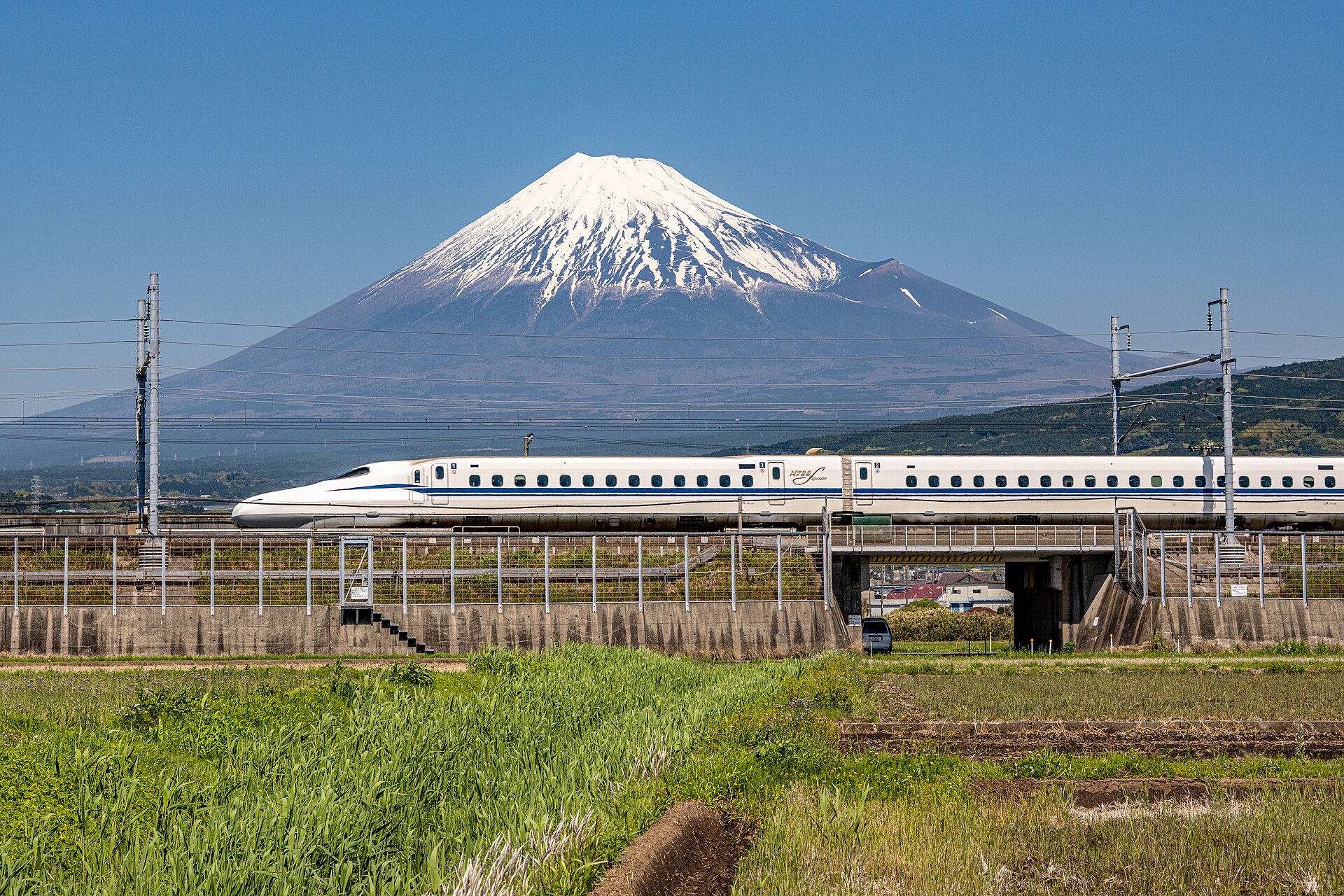
Photo Credit
Image courtesy of © Takeshi Aida (CC BY-SA 2.0), via Wikimedia CommonsOn 27 September 1825 a steam engine hauled several hundred delighted passengers, some perched on coal, across County Durham, and the world began to shrink. Two centuries later, trains glide at 320 km/h beneath Mount Fuji and a Japanese maglev has touched 603 km/h. Here is how the railway rewired time, cities and travel, from George Stephenson to the bullet train.
A colliery boy who could not read
George Stephenson was born at Wylam, near Newcastle, on 9 June 1781, to parents who could neither read nor write, and he stayed illiterate until 18, paying for night school out of his wages. He learnt engines the hard way, keeping the pumps of Northumberland pits alive, and in 1814 built his first locomotive, Blücher, for the Killingworth wagonway, named after a Prussian general famous for arriving at speed.
He also chose a gauge. The 4 ft 8½ in between the rails that Stephenson favoured became the standard gauge used by most of the world’s railways, which means a decision taken among the coal waggons of the North East still sets the width of track from Madrid to Beijing. Few engineers have been copied so widely by people who have never heard of them.
1825: the day the railway age began
The Stockton and Darlington Railway, the first public railway to use steam locomotives, opened on 27 September 1825. Its engine, Locomotion No. 1, built by the Stephensons’ own company, hauled coal waggons fitted with seats and a coach called Experiment. The directors had allowed for 300 passengers; somewhere between 450 and 600 climbed aboard, some riding on top of the coal. It was the first railway crowd, and it was already over capacity.
The company’s Latin motto, Periculum privatum utilitas publica, means “at private risk for public service”, which neatly sums up two hundred years of railway finance. Passengers were carried in horse-drawn coaches until 1833, while steam hauled the coal. The anniversary has been celebrated in 1875, 1925, 1975 and, with a great deal of steam, in 2025.
Rainhill: the talent show that chose the future
The Liverpool and Manchester Railway needed to know whether locomotives or stationary engines hauling ropes should work the line, so in October 1829 it held a contest at Rainhill, with a £500 prize. The entrants were wonderfully varied. Cycloped was powered by a horse walking on a belt, and withdrew after the horse burst through the floor. Novelty was light and quick but unreliable; Sans Pareil turned up overweight.
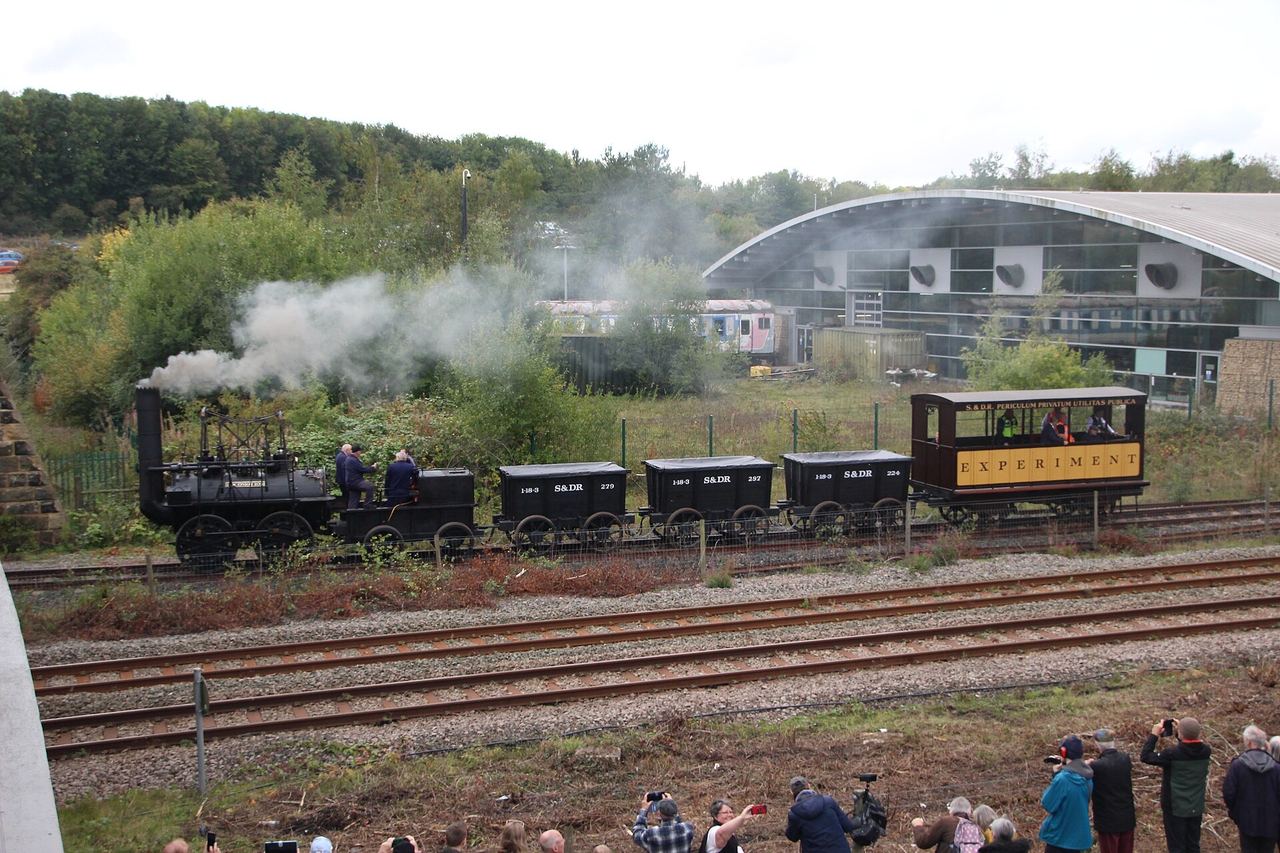
Photo Credit
Image courtesy of © LJWil (CC BY 4.0), via Wikimedia CommonsRocket, designed and built by Robert Stephenson at the family works in Newcastle, beat the required 10 mph average by more than 40 per cent and ran light at around 30 mph. Its secret was a boiler with 25 copper fire tubes, which made steam faster than anything else on the field and became the template for steam locomotives ever after. Rocket now lives at the National Railway Museum in York, a little scorched and very proud.
1830: the first inter-city railway
The Liverpool and Manchester opened on 15 September 1830, the first inter-city railway in the world. It was the first to rely only on steam locomotives, the first to be double track throughout, the first with a true signalling system, the first fully timetabled and the first to carry the mail. Stephenson drove it across Chat Moss, a peat bog that one rival engineer called a serious error. The modern railway, in short, arrived in one go.
Brunel and the battle of the gauges
Then came Isambard Kingdom Brunel, engineer of the Great Western Railway from London to Bristol, who laid out his route to minimise curves and gradients and chose a broad gauge of 7 ft ¼ in for speed and comfort. Critics warned that a runaway train in his Box Tunnel, the longest in the world at the time, would reach 120 mph and leave passengers unable to breathe. They breathed; the tunnel is still in use.
Brunel lost the gauge war. When a Royal Commission heard 46 witnesses in 1845, only Brunel and his Great Western colleagues supported the broad gauge, and Stephenson’s narrower track won. Brunel and Robert Stephenson, the two titans of Victorian engineering, died within a month of each other in 1859. Between them they left bridges, tunnels and stations that trains still use every day.
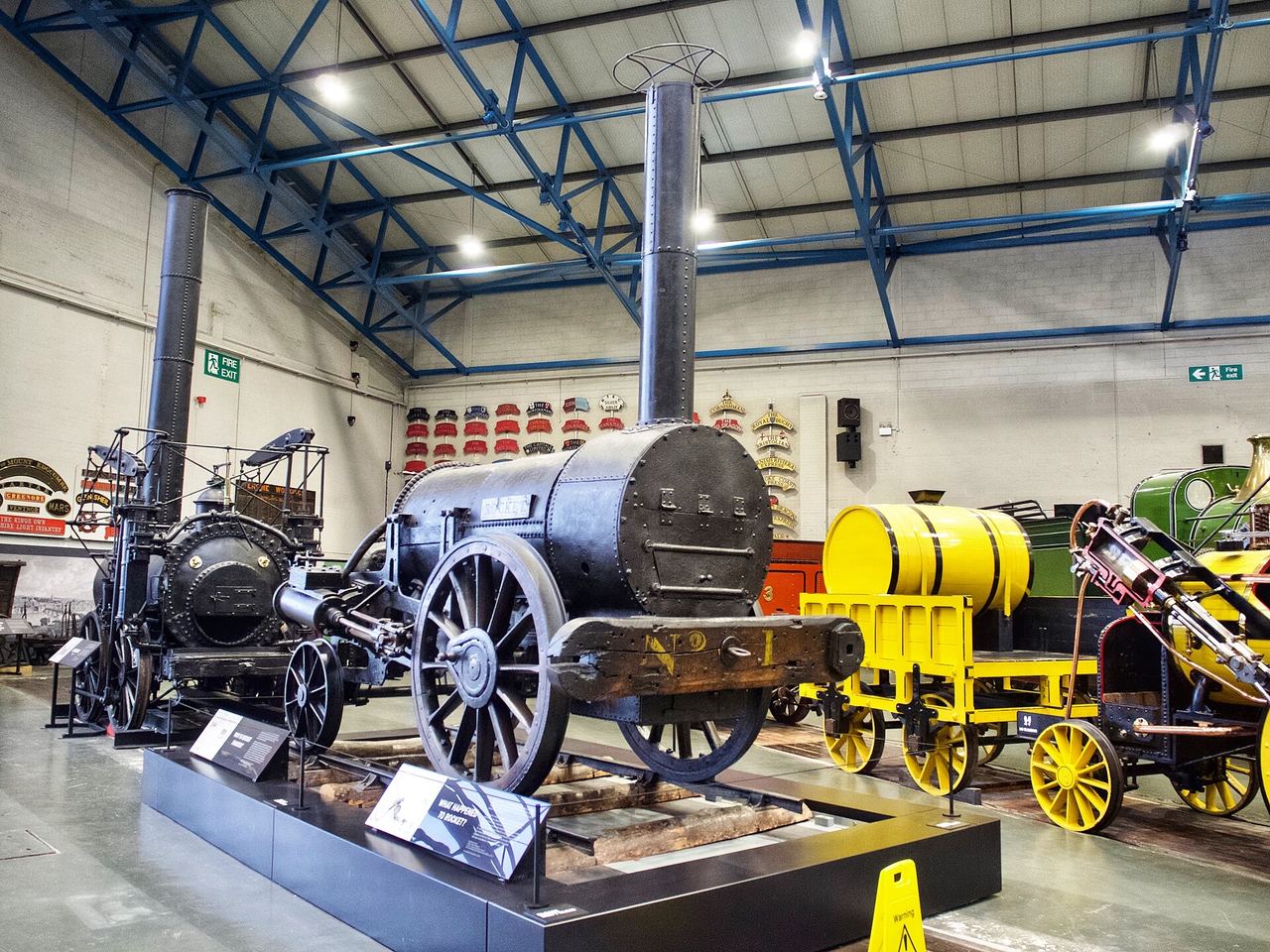
Photo Credit
Image courtesy of © Malcolmxl5 (CC0), via Wikimedia CommonsWhat the railway did to time
Before trains, every town kept its own time by the sun: Bristol ran ten minutes behind London, Leeds six. That was charming at the pace of a horse and chaos at the pace of a timetable. In November 1840 the Great Western began running all its services on London time, the first recorded use of a single standard time. Bristol’s public clock acquired a second minute hand, one for the city and one for the trains.
Before the railway, every town kept its own time; the train made the whole country agree on what o’clock it was.
Railway time spread across Britain so quickly that the law caught up only in 1880, when a single standard time became official. In North America and India, local differences could run to an hour or more. The train had done something no philosopher managed: it made everyone agree on what time it was. Cities changed shape too, as stations pulled suburbs out into the fields; Paddington, when Brunel chose it, was a village on the edge of London.
Steam’s last sprint, then diesel and electric
Steam went out at full gallop. On 3 July 1938 the streamlined LNER locomotive Mallard, designed by Nigel Gresley, reached 126 mph, the world speed record for steam, which still stands. Its blue casing looks less built than poured. After the war, diesel and electric traction took over; in Britain, the diesel InterCity 125 began running between London and Bristol at 201 km/h in October 1976, on Brunel’s old route.
1964: Japan invents the bullet train
Japan’s Tōkaidō Shinkansen opened on 1 October 1964, just before the Tokyo Olympics, the world’s first high-speed line. Its 0 Series trains ran at up to 210 km/h, and the journey between Tokyo and Osaka, about six hours 40 minutes by the old limited express, fell to four hours and later three hours ten. The rounded nose gave the English language a new phrase: the bullet train.
What has impressed the world since is less the speed than the discipline. Over more than 60 years and more than 10 billion passengers, the Shinkansen has had no passenger fatalities from derailments or collisions, despite earthquakes and typhoons. In 2016 JR Central reported that its average delay per train was 24 seconds. Today’s Shinkansen run at up to 320 km/h, with 360 km/h planned for the late 2030s.
France answers: the TGV
France’s TGV opened between Paris and Lyon on 27 September 1981, 156 years to the day after the Stockton and Darlington, a neat bow tied across a century and a half. Today its trains run at up to 320 km/h, and in 2025 the network carried 168 million passengers. On 3 April 2007 a specially modified TGV reached 574.8 km/h on the line to Strasbourg, still the world record for a train on wheels.
Eurostar: through the Channel
Eurostar began running from London Waterloo to Paris and Brussels on 14 November 1994. On 14 November 2007 it moved to a restored St Pancras International, with London to Paris in two hours 15 minutes. Its trains run at up to 300 km/h on the high-speed lines, slowing to 160 km/h in the Channel Tunnel. Since 2023 it has also carried the old Thalys routes, and in 2025 it carried a record 20 million passengers. A crossing that once meant a ferry and a strong stomach now lasts a coffee.
Floating trains: maglev
Magnetic levitation removes the wheels altogether. The Shanghai maglev, the first commercial high-speed maglev, has run since 2004 between Pudong International Airport and Longyang Road, about 30 km, in roughly eight minutes. It once cruised at 431 km/h, the fastest train in regular service, but since May 2021 has run at 300 km/h. Even so, the trees still go past like a flicked deck of cards.
Japan’s answer is faster still. On 21 April 2015 a seven-car L0 Series maglev reached 603 km/h on the Yamanashi test line, the land speed record for rail vehicles. It is the prototype for the Chūō Shinkansen, a line mostly in tunnels that aims to link Tokyo and Nagoya in 40 minutes at up to 505 km/h. Construction has been slower than the train: the original 2027 opening has slipped to 2035 at the earliest.
The fastest trains today, as officially stated
On regular wheels, China’s Fuxing CR400 trains run at up to 350 km/h, among the fastest wheeled trains in regular service. The newer CR450 is designed to run at 400 km/h, but has not yet entered regular service at that speed. Japan’s Shinkansen and France’s TGV run at up to 320 km/h, Eurostar at up to 300 km/h, and the Shanghai maglev at 300 km/h. Rocket, for the record, managed about 30 mph, roughly 48 km/h.
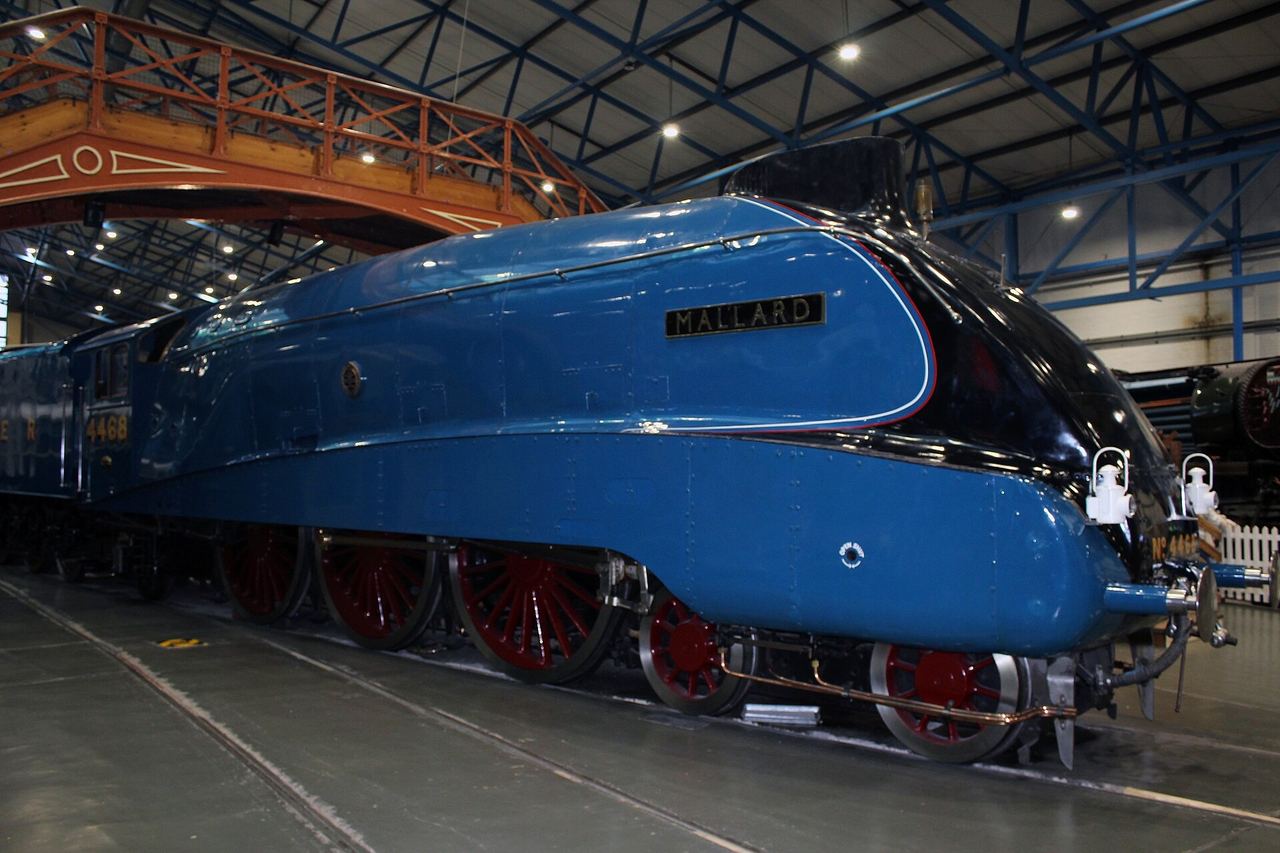
Photo Credit
Image courtesy of © Bill Tyne (CC BY-SA 4.0), via Wikimedia CommonsWhere to see the story
Our advice: start at the National Railway Museum in York, where entry costs nothing and Rocket, Mallard and a Shinkansen bullet train share one roof, two centuries of speed within a few minutes’ walk. In County Durham, the Locomotion museum at Shildon sits where the 1825 railway began. Then take the long view at speed: London to Paris on Eurostar, Paris to Lyon on the TGV, Tokyo to Osaka on the Shinkansen.
Why it's on our list
- George Stephenson and the Stockton and Darlington
- Rocket and the Rainhill trials
- Brunel and the battle of the gauges
- How railways invented standard time
- Shinkansen, TGV, maglev and Eurostar
- Top speeds, as officially stated
Location
The map comes from Google Maps, which sets its own cookies once it loads.
More in depth
 ScienceTesla, Edison and the inventors who wired the worldAC v DC, Niagara, the light bulb and Tesla’s lightning: the inventors who wired modern life.
 ScienceRobots, algorithms and the new medicineSurgical robots, AI that reads scans, AlphaFold and new drugs: the gains, the limits, the questions.
 ScienceAI and wildlife: the machines that listen for the wildCamera traps, whale codas, ranger dashboards and satellites: how AI is changing conservation.