The Observatory
Pearls on a thread: the satellites that wired the sky
Starlink, OneWeb, Amazon Leo and China’s networks: internet from orbit, and the night sky’s cost.
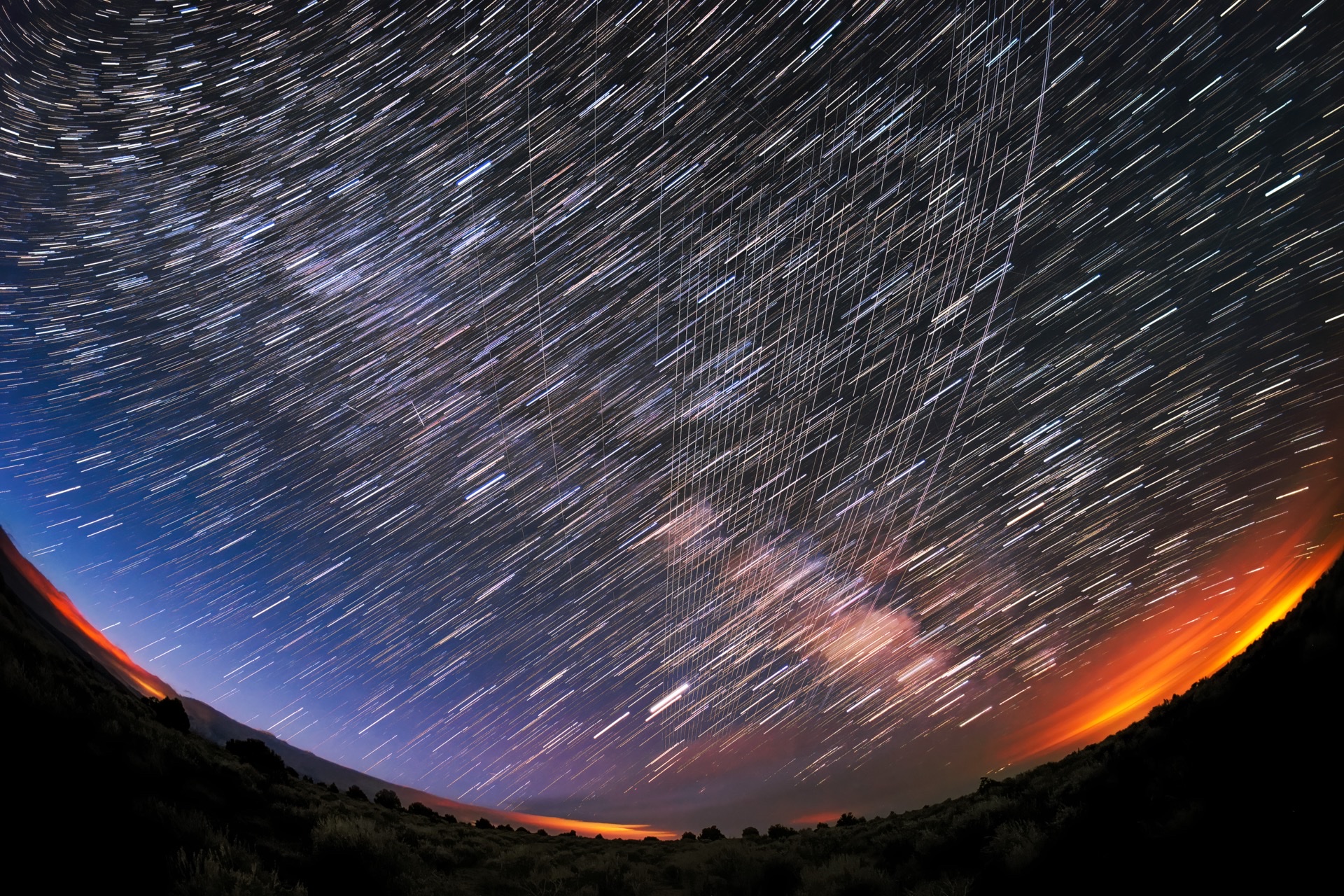
Photo Credit
Image courtesy of © M. Lewinsky, Creative Commons Attribution 2.0 (via NOIRLab)Thousands of satellites now circle in low Earth orbit, bringing the internet to ships, aircraft and the remotest towns. Astronomers count the cost in streaks across their images. Here is how low-orbit internet works, how many satellites fly, and what operators and observatories are doing about the night sky, checked against the companies’, agencies’ and observatories’ own pages in November 2026.
A new net around the planet
Look up an hour after dusk and you may catch it: a line of lights sliding across the sky in single file, like pearls drawn along a thread. It is a fresh batch of internet satellites, still low and bright on the way up to work. SpaceX launched its first 60 Starlinks in May 2019, and the IAU’s dark-sky centre says that launch made astronomers acutely aware of what constellations would mean for the night sky.
The idea is geometry. ESA counts anything below 2,000 km as low Earth orbit, while the classic telecommunications satellites hang at 35,786 km, keeping pace with Earth’s spin. Down low the signal’s journey is a fraction of the distance, but each satellite races along at about 7.8 km a second and circles the planet in roughly 90 minutes. None stays overhead for long, so they work as a constellation, handing you on: a relay race that never ends.
SpaceX calls Starlink the world’s largest constellation. Its 2025 progress report describes more than 9,000 active satellites, more than 9 million customers on all seven continents and more than 300 dedicated Falcon 9 launches. The satellites talk to each other by laser, so traffic from mid-ocean can hop from satellite to satellite until it reaches the internet on land; in 2025 the company launched more than 120 missions just for Starlink.
Others fly at other heights. Eutelsat’s OneWeb has more than 600 satellites in 12 orbital planes 1,200 km up. Amazon renamed Project Kuiper as Amazon Leo in November 2025; its satellites are released at about 465 km and climb to 630 km. Amazon counts nearly 400 launched, though a Vulcan rocket carrying Leo satellites lost its payload on 15 November 2026. China’s CASC launched its 24th group of low-orbit internet satellites in August 2026.
Connected at sea and in the air
The benefit is easiest to see from a deckchair. Starlink says it connects more than 150,000 vessels, from tugs to cruise ships, and served more than 20 million cruise passengers in 2025, when more than 1,400 commercial aircraft were also fitted. On land it describes Nome, Alaska, kept connected by satellite for months after its undersea fibre broke in January 2025. The holiday that once excused you from email no longer does.
The astronomers’ view
Astronomy saw the other side early. In November 2019 astronomers Clara Martínez-Vázquez and Cliff Johnson, observing with the Dark Energy Camera on the Víctor M. Blanco 4-metre Telescope in Chile, found at least 19 streaks across one 333-second exposure, left by the second batch of Starlinks. NOIRLab explains that such trails wash out the light of distant stars and galaxies, and that removing the faint ones afterwards leaves residues of its own.
The stakes are highest at the NSF–DOE Vera C. Rubin Observatory on Cerro Pachón, which officially began its ten-year Legacy Survey of Space and Time in June 2026. Its 3,200-megapixel camera, the largest digital camera in the world, takes an image about every 40 seconds. Rubin calls low-orbit satellites “a real challenge”: a simulation with 40,000 of them found about 10% of images would carry a trail, and most twilight images would.
The holiday that once excused you from email no longer does.
Astronomy’s voice is the IAU Centre for the Protection of the Dark and Quiet Sky from Satellite Constellation Interference (IAU CPS), launched in April 2022 and co-hosted by NSF NOIRLab and the SKA Observatory. It asks that satellites never be visible to the unaided eye. Its November 2026 count: 13 large constellations launched, 13,177 of their satellites in orbit and 2,330,657 in filings. Only a fraction ever fly; it is still a lot of commas.
Mirrors, paint and paranoia
SpaceX has published its own engineering answer. Its first fix, sun visors, blocked the satellites’ laser links and added drag, so they went. In their place came a dielectric mirror film that bounces sunlight away from Earth, and the white backing between the solar cells was dyed dark red, though it runs hotter and costs performance. Rubin notes that there are no regulatory limits on reflectivity outside the radio spectrum.
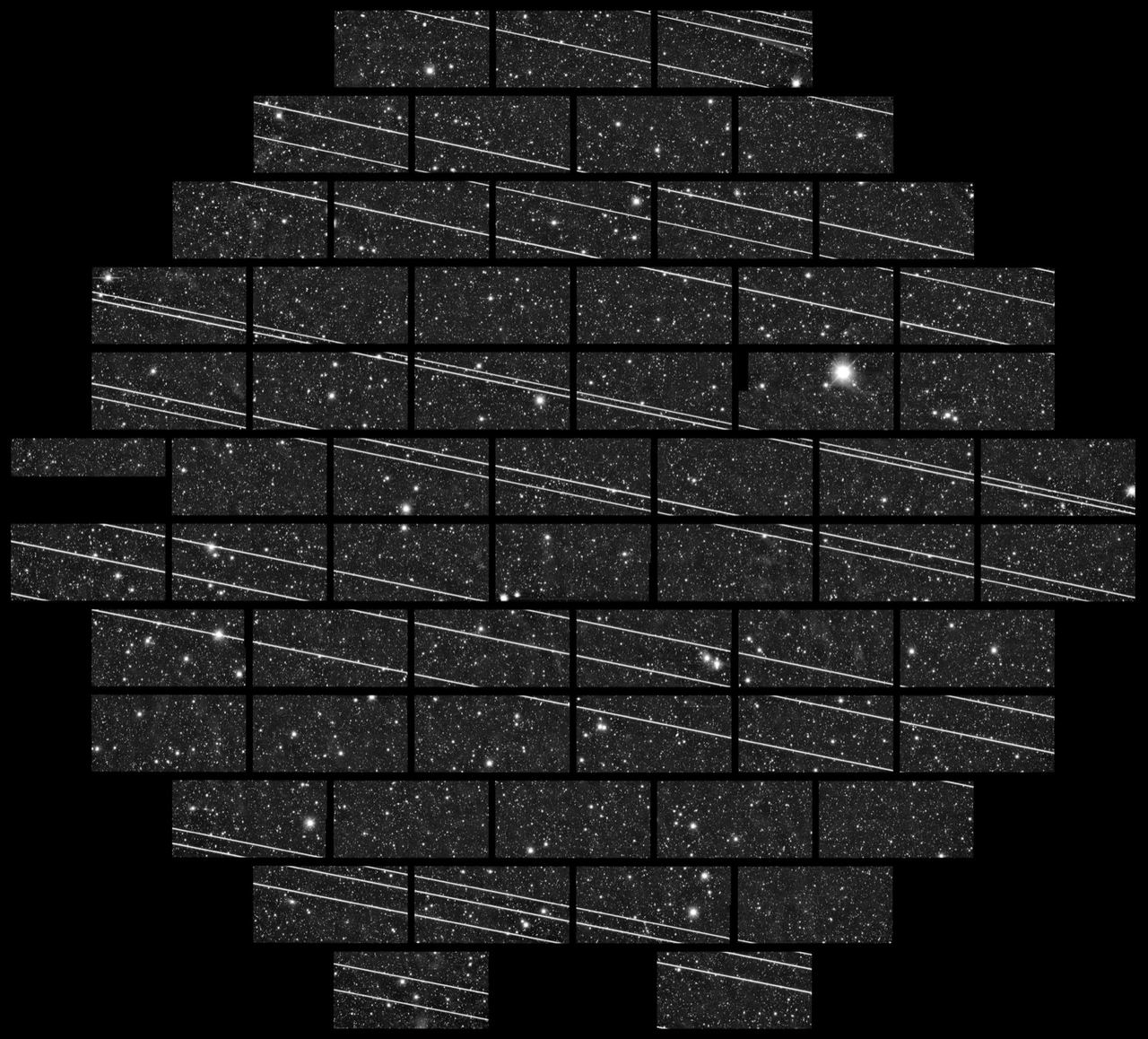
Photo Credit
Image courtesy of © CTIO/NOIRLab/NSF/AURA/DECam DELVE Survey, CC BY 4.0The second generation goes further: a mirror film SpaceX rates ten times better, a “Low Reflectivity Black” paint for awkward parts, and solar arrays turned edge-on near the day–night line, at a cost of 25% of the power. The aim is satellites invisible to the naked eye once on station; they are brighter after launch and while climbing or descending. SpaceX also said it would offer the film at cost to other operators.
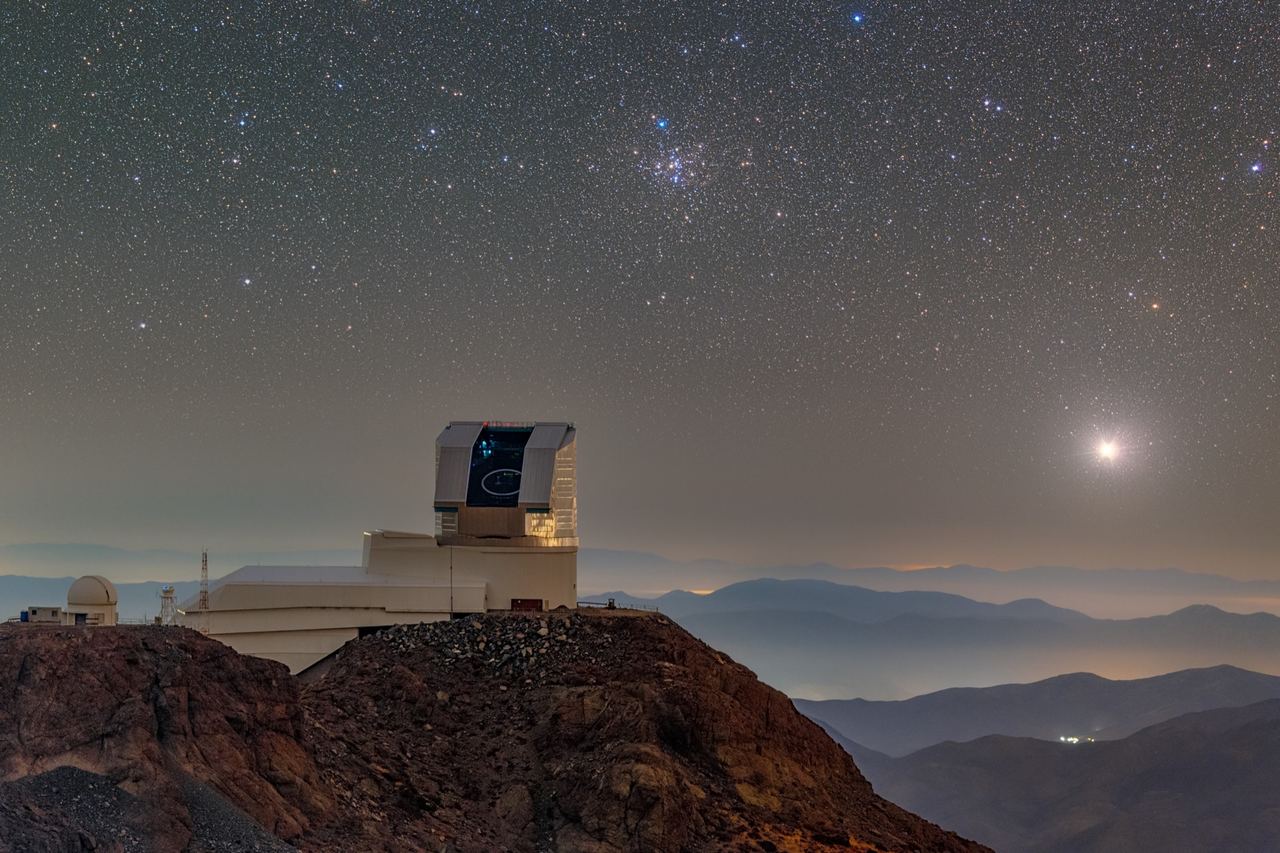
Photo Credit
Image courtesy of © NSF–DOE Vera C. Rubin Observatory/NOIRLab/SLAC/AURA/P. Horálek (Institute of Physics in Opava), CC BY 4.0What goes up now comes down on schedule. ESA counts 1,200 intact objects re-entering in 2025. Starlink steers old satellites down over open ocean, designed to burn up, while it retains, in its own words, “the paranoia that we might be wrong”. In October 2026 ESA became the first space agency to join the IAU CPS; its Director of Operations, Rolf Densing, spoke of a future where generations “can still enjoy an unobstructed view of the stars”.
Our advice: satellite trains show best in the first days after a launch, in the first hours of darkness or before dawn; a long camera exposure will find the rest. For a sky they barely touch, travel to a recognised dark-sky place far from towns. To follow the debate, the IAU CPS home page keeps its constellation count current, Rubin publishes its satellite FAQ, and each operator posts its own launch updates.
Closer to home: Brighton
The University of Sussex’s Astronomy Centre studies the early Universe, observational cosmology and how galaxies form and evolve, and its researchers are active members of the Rubin Telescope’s LSST, Euclid and 4MOST. East of the city, the green domes of the former Royal Greenwich Observatory still stand at Herstmonceux, now the Observatory Science Centre, with stargazing evenings on its historic telescopes.
Why it's on our list
- A new net around the planet
- Connected at sea and in the air
- Mirrors, paint and paranoia
Location
The map comes from Google Maps, which sets its own cookies once it loads.
More in depth
 The ObservatoryLondon to New York in two hours? The long, quiet road back to supersonicConcorde’s legacy, NASA’s quiet X-59, Boom’s Overture and the hypersonic dreamers, by status.
 The ObservatoryEleven minutes, or a fortnight: the people who sell you the skySuborbital hops, private orbits, a stratospheric balloon: who flies, from where, and when.
 The ObservatoryRooms with a view of everything: the race to build hotels in orbit and on the MoonPrivate stations, a Hilton cookie, a hotel on the Moon: who is building what, and how far along.