The back story
The Pump House: the back story
A tile-fronted Lanes pub with a name older than the Pavilion and a 1950s interior worth a pint.

Photo Credit
Image courtesy of © Hassocks5489 · CC0 via Wikimedia CommonsThe Pump House on Market Street looks like a cheerful Lanes pub, which it is. It is also one of the oldest drinking addresses in Brighton, with a name recorded on the site by 1776, a front that pretends to be brick and an interior that historians of the British pub now rank among the country’s best survivors.
Brighton has plenty of pubs that claim to be the oldest, and they cannot all be right. The Pump House, on Market Street in the Lanes, makes no such boast over the door, but it has the paperwork to sit near the top of any shortlist.
A name older than the Pavilion
The name was attached to a building on this site at least as early as 1776, years before the Prince of Wales discovered the town. Where it came from is still argued over. One theory points to the old town well that stood nearby on the Knab, now Brighton Place; another, favoured by local beer historians, to a timber pier with a pump house that sent seawater ashore for the fashionable new craze of bathing.
Either way, the pub belongs to the fishing town that came before the resort. The narrow lanes around it still follow the street plan of that old town, which is why the walk to the bar can feel longer than it is.
The front that isn’t brick
The building is listed Grade II, together with its neighbours at Nos 44 to 46. Its late eighteenth or early nineteenth-century front may hide an older building behind, and it is hung with mathematical tiles: tiles shaped and pointed to look like brickwork, the same Georgian trick you can see on Royal Crescent. Below, a run of curved shop windows framed by Tuscan pilasters gives the street front its bow-windowed charm.
Two houses, one pub
For most of its life the pub occupied a single house, No. 46, where trade directories list landlords from the 1850s; one of them, Henry Croker, was behind the bar for at least a quarter of a century, from before the First World War to 1938.
The panelling in the front bar was once the first floor. In 1954 the pub took its own upstairs apart and wore it.
In 1954 the Kemp Town Brewery joined it to No. 45 next door and rebuilt the interior as a set of small rooms around a central servery. A room at the back came into pub use only in 1980, but the heart of the place is still the brewery’s mid-century work.
Inside the 1954 bars
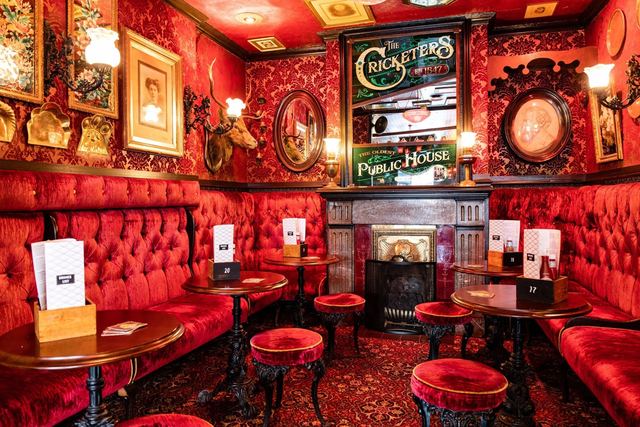
That work is why the Campaign for Real Ale lists the Pump House among the pub interiors of special national historic interest. The two front bars keep their 1950s curved counters and floor-to-ceiling panelling, along with fixed seating, fireplaces and an entrance vestibule. The panelling in the left-hand bar was made from timber taken out of the building’s own first floor.
Order a pint
Today the Pump House is run as part of the Nicholson’s group, with food, a room upstairs for functions and a steady crowd of shoppers, office workers and visitors finding their way out of the Lanes. Take your drink into one of the panelled front rooms, look at the counter, and remember that the brewery that built it has long gone while its bar is still being leaned on.
Questions and answers
How old is the Pump House in Brighton?
The name was in use on the site at least as early as 1776; the building’s front dates from the late eighteenth or early nineteenth century and may hide an older structure.
Why is it called the Pump House?
No one is certain: it may come from the old town well nearby, on what is now Brighton Place, or from a pump that sent seawater ashore for bathing.
Is the Pump House a listed building?
Yes, Grade II, and its 1950s interior is listed by CAMRA as one of special national historic interest.
Why it's on our list
- A name older than the Pavilion
- The front that isn’t brick
- Two houses, one pub
- Inside the 1954 bars
- Order a pint
Location
The map comes from Google Maps, which sets its own cookies once it loads.
More in depth
 The back storyFireside pubs: where to drink in Brighton when it’s coldOpen fires, wood-burners and snug old rooms: the pubs to head for when the wind comes off the sea.
 The back storyGrand hotels and Regency townhouses: where to stay in BrightonGrand Victorian hotels, Regency townhouses and art-filled small hotels: where to stay, and why.
 The back storyFrom Brighthelmstone to Brighton: a fishing town turned fashionable resortA fishing town turned England’s most fashionable resort: sea-bathing, a prince’s palace, the piers.