The back story
Brighton Mitre Cycling Club: the back story
Founded at a Queens Road pub in 1894: records, Beacon hill climbs and how to join a Sunday ride.
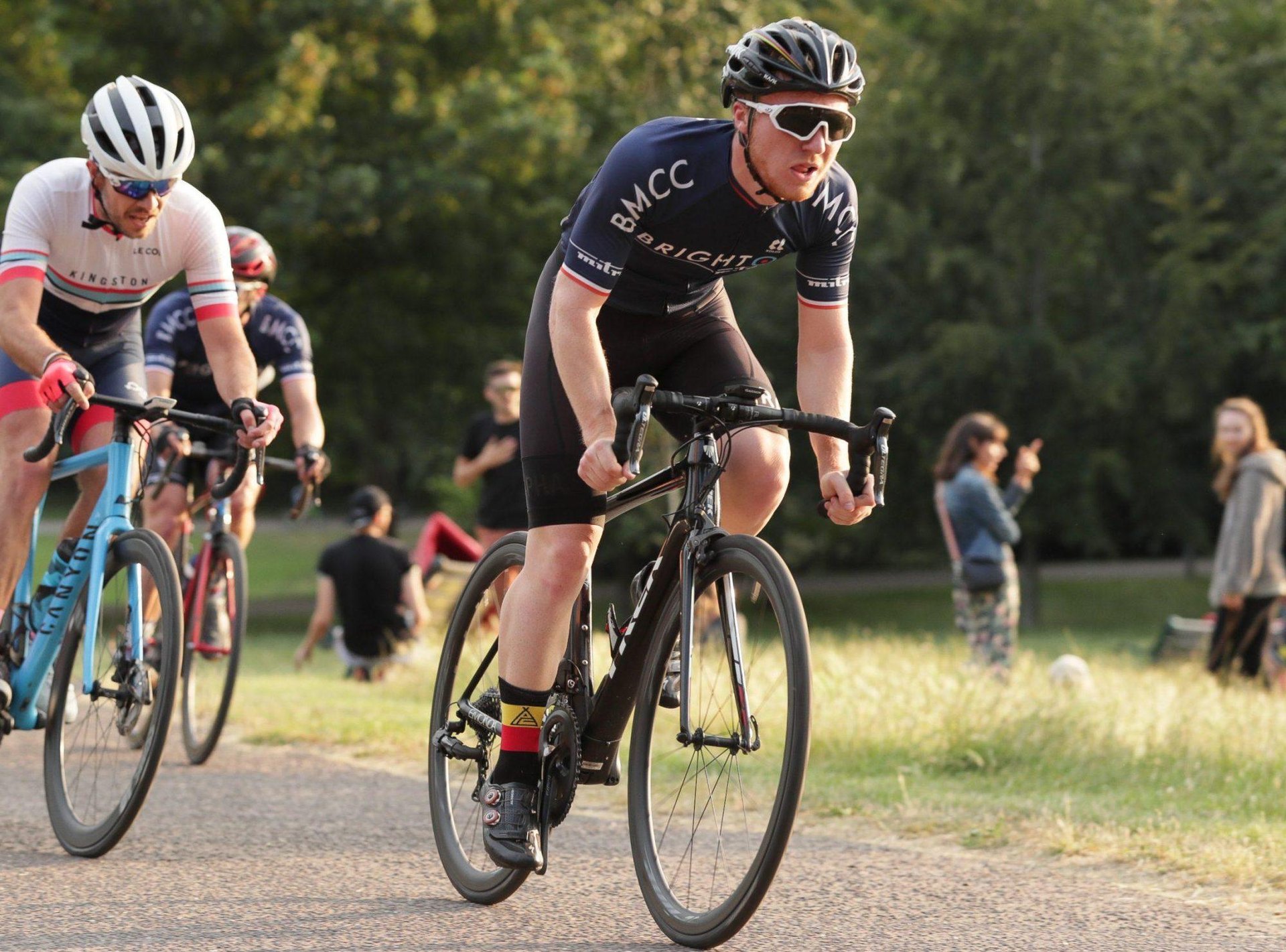
Photo Credit
Image courtesy of © Brighton Mitre Cycling ClubBrighton Mitre Cycling Club was founded in 1894 at the Mitre Hotel on Queens Road and is larger today than ever. Its Tuesday time trials, its hill climbs up Ditchling Beacon and Mill Hill, its record book from 1935 and its Sunday rides from St Ann’s Well Gardens, open to newcomers.
Some cycling clubs are named after a hill, a saint or a Latin motto. Brighton’s oldest is named after a pub. In 1894 a group of riders began meeting at the Mitre Hotel on Queens Road, a short freewheel from the station, and the club that took its name is still on the road. It has seen the age of the motor car, some very lean years and the great British bike boom. More than 130 years on, it is larger than it has ever been.
A club named after a pub
Brighton Mitre Cycling Club was formed in 1894, and its name came from its first meeting place, the Mitre Hotel at 65 Queens Road. By 1926 the headquarters had moved up the road to the Elephant and Castle, on the corner of London Road and Francis Street. Today the club gathers every weekend at the café in St Ann’s Well Gardens in Hove, which suits a sport that now runs on coffee as much as on beer.
The club’s own record book reaches back to the 1930s: J A Knight’s sprint times on the Preston Park track date from 1935 to 1939, and in 1935 J W Rassell set the club’s track marks at five, ten, fifteen and twenty miles, all on the track in Preston Park.
Lean years and a telephone box
Cycling’s fortunes in Britain followed the car. The Department for Transport’s figures show that riders covered some 14.7 billion miles on British roads in 1949, and that cycle traffic fell fastest in the 1950s and 1960s, as car ownership climbed.
The early 1990s, an obituary of a long-serving secretary on the club’s own website recalls, were a lean time for clubs in general and the Mitre in particular, which had only some 30 members. It was said that the committee could meet in a telephone box. Yet the same small club still organised a National 24 Hours Championship in 1994, which is rather like a village hall staging an opera, and getting the orchestra to ride there.
The great British bike boom
Then the tide turned. According to the Department for Transport, cycle mileage on Britain’s roads rose by 38.3 per cent in the 25 years to 2019, reaching 3.5 billion miles that year; still only around a quarter of the 1949 figure, but a long climb back from the bottom. Those were the years of British Olympic gold on the track and, from 2012, British winners of the Tour de France.
The Mitre grew with them. Its Saturday rides now split into fast, medium and social groups, and in summer it is not uncommon to see three or four groups at the social and medium paces alone. Kit is made to order by Kalas in the club colours, and for the 125th anniversary members could buy a one-off white jersey, now as rare on the road as a flat route out of Brighton.
The racing calendar widened too, with a women’s category at every club time trial and hill climb, open events on bank holidays and summer criteriums in Hove Park, and the club has hosted London X League cyclo-cross in East Brighton Park. Young riders from Preston Park Youth Cycle Club now line up beside Mitre members at the hill climbs.
The record book
The club records page is a social history written in minutes and seconds. The oldest of its road endurance records belongs to H Breden, who rode 427.621 miles in 24 hours in 1954, an average of almost 18 miles an hour, through the night. R Smith rode 248.18 miles in twelve hours in 1976, and M Beeston set the women’s twelve-hour record of 213.66 miles in 1963; both still stand.
R Johnson holds five of the six senior place-to-place records, set between 1967 and 1971, including Brighton to Worthing and back in 53 minutes 38 seconds, and a 25-mile record from 1981 ridden on a restricted 72-inch gear, a period piece of the time-trial world. On the track, R C King’s standing kilometre of 1 minute 17.4 seconds has stood since 1952, and C Oxborrow covered 40 kilometres and 736 metres in an hour at Preston Park in 1977.
The modern era belongs largely to Cris Coxon, who holds the men’s 10, 15, 30 and 50-mile records, set in 2024 and 2025, with the ten at 18 minutes 58 seconds; the club’s own pages call him a former national time-trial champion in the road-bike category. Adrian Ford holds the 25 at 48 minutes 30 seconds. Among the women, L Brama set the 10, 25, 30 and 50-mile records in 2013, A Greenaway the 100 in 2021 and Kerry McGaw the 15 in 2024.
The race of truth
Time trials, the club says, are known as the race of truth: no tactics and no teammates to hide behind, just one rider against the clock, set off at one-minute intervals. Their quirks have an outlaw past. As the club tells it, the sport grew up when racing on public roads was banned, so riders started at dawn, dressed in black and gave their courses coded names so that it was not obvious where a race was being held.
The codes survive. Brighton sits in Cycling Time Trials’ London South district, whose courses begin with the letter G; the Steyning to Shoreham ten, for instance, is G10/97. The early starts survive too, now for the sake of quieter roads rather than discretion.
The committee, it was said, could meet in a telephone box.
The Mitre’s club events run on Tuesday evenings in spring and summer: in 2026 they took in hill climbs and a series of ten-mile time trials on the course at Wineham. They are free for members and £5 for non-members, with open and female categories, and you can ride an ordinary road bike in a road-bike category. The rules are short and strict: a helmet and working front and rear lights, or no start. Enter online before the event.
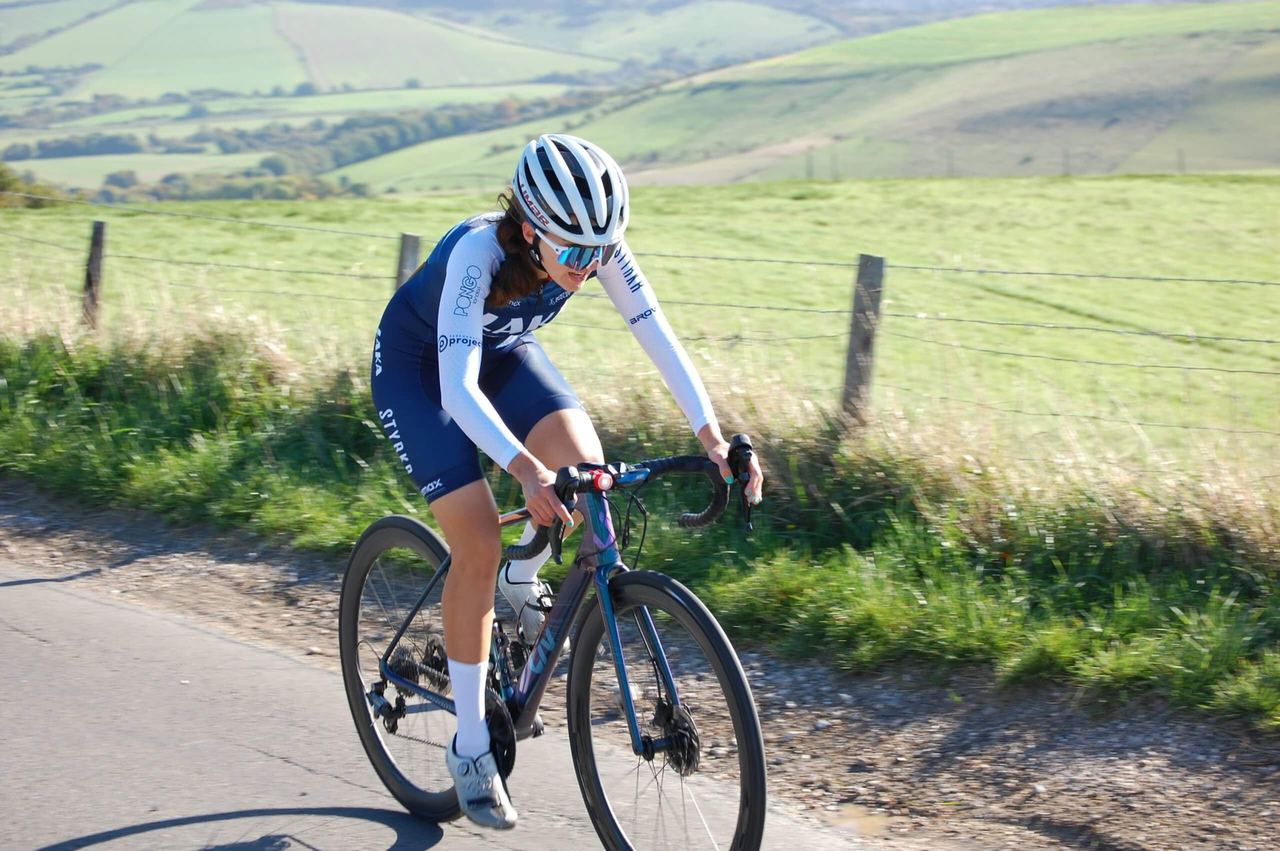
Photo Credit
Image courtesy of © Brighton Mitre Cycling ClubOpen events are more formal: entries close about two weeks ahead and riders are seeded, the fastest starting last. The Mitre’s own include a hilly 27.3-mile event over Devil’s Dyke at Easter, a flat ten and a hilly ten on the late-May bank holiday and an end-of-season 25 in October. Check dates and enter on the Cycling Time Trials website.
Ditchling Beacon and Mill Hill
A hill climb is a time trial that goes uphill; on the Downs, short and savage. Ditchling Beacon is the classic. The Cycling Time Trials course, GH/90, starts in Ditchling Bostal just south of the junction with Underhill Lane and finishes just past the car park on the summit, 1,576 yards later, after a climb of about 148 metres at an average of almost 9 per cent. The road hangs off the north face of the Downs like a rope ladder.
On a fine August evening in 2026, 36 riders turned out for the Mitre’s Beacon climb, and the fastest went up in under five minutes. Most riders take rather longer, and the view from the top is the same for everyone. To keep riders from being held up behind a car, the organiser has sent them off fastest first.

Mill Hill, above Shoreham, is the longer test: the GH/94 course runs for 3 miles and climbs about 141 metres. It kicks up to around 10 per cent just after the start, eases, drops through two fast downhill sections on a road that narrows in places, turns sharp right after about 3 kilometres and finishes with a 1.4-kilometre drag at around 4 per cent. Riders gather in the car park north of the bridge over the A27.
Club hill climbs run from April into early September, ahead of the national hill-climb season in September and October, when there are open climbs nearby at Steyning Bostal and Titch Hill. Bad weather may cancel a time trial; it rarely stops a hill climb. You do not need a featherweight bike: as the club puts it, “just turn up, have a laugh and give it a crack”.
Track nights and the Hove Park Crits
Preston Park’s Victorian velodrome, which the club describes as the oldest track in continuous use in the world, is a 579-metre outdoor circuit with an unusual D shape and flint-edged banks where crowds in their thousands once watched the racing. From April to August the Sussex Cycle Racing League runs a track league there on Wednesday evenings from 6.45pm; you need a fixed-gear track bike, which can be hired at the track, and a racing licence.

Photo Credit
Image courtesy of © Hassocks5489 · CC0 via Wikimedia CommonsIn early summer the club stages the Hove Park Crits on a closed circuit of about a kilometre at the northern end of Hove Park: a Friday evening of six races, youth riders first, finishing with the open and women’s races. Riders need a British Cycling licence, or a day licence where offered. For spectators it is one of the city’s best summer evenings out: bring a blanket.
Your first ride with the Mitre
The door in is the Sunday ride. On the first and third Sundays of each month the club runs two led, non-drop rides that welcome non-members: the Sunday Social at 12–14mph over 25–35 miles, and the Sunday Steady at 14–16mph over 30–35 miles. If you have never ridden in a group before, start with the Social.
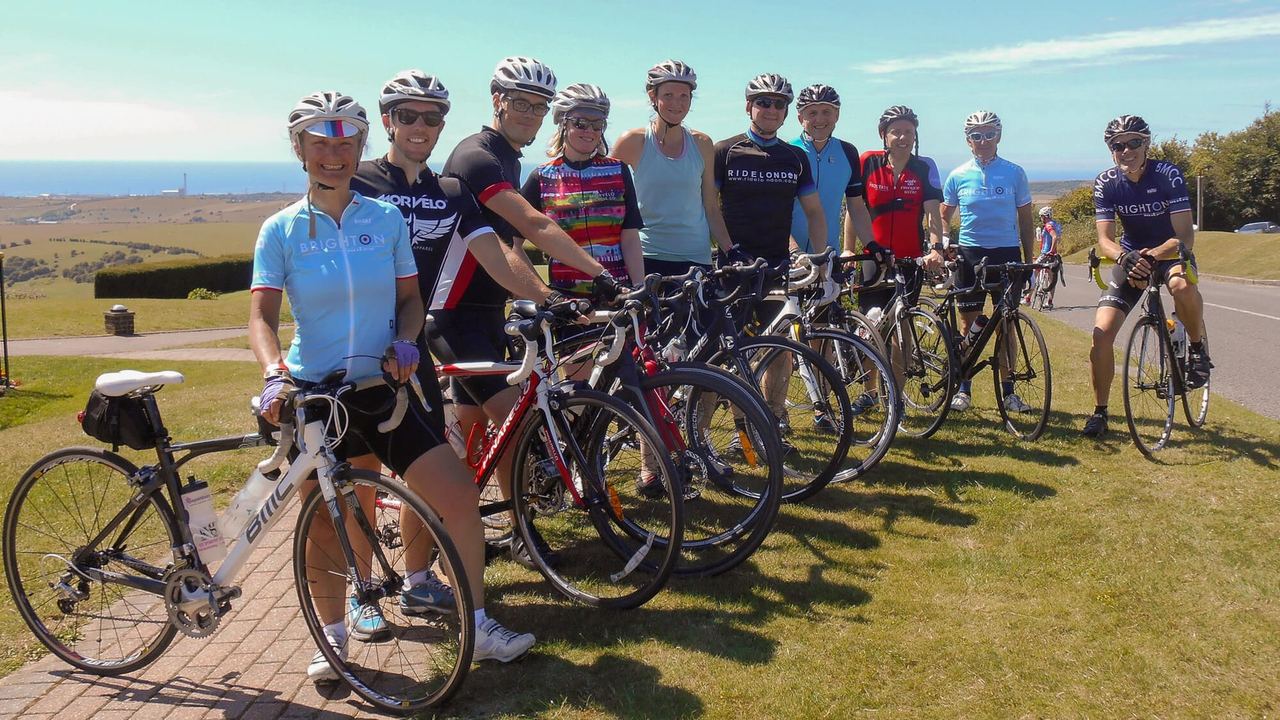
Photo Credit
Image courtesy of © Brighton Mitre Cycling ClubMeet from 9am at the café in St Ann’s Well Gardens, Hove, for coffee and a briefing; the groups roll out at 9.30am. There is no need to book. Rides usually have two leaders, one at the back so nobody is left behind; groups regroup at junctions, are capped at eight riders and almost always stop for coffee. Expect hills: most good routes out of Brighton and Hove cross the South Downs.
Bring a road bike in good working order (a flat-bar bike is welcome if you can hold the pace), but no tri-bars or aero bars. Carry food, two bottles, spare tubes, tyre levers, a pump and a puncture kit, money for cake, and emergency contact and health details. Helmets are not compulsory, but the club strongly expects them. In winter a full rear mudguard is required, and rides are cancelled after a freezing night or in very high winds.
On the road, the rules are simple and serious: obey the Highway Code, ride no more than two abreast, go single file when traffic queues behind, signal hazards, and slow right down, talk to the rider and pass wide when you meet horses on the lanes.
You may ride twice as a guest; after that the club expects you to join. Membership costs £25 a year, January to December, through the club’s Spond app (under-18s need a parental consent form). Every member needs third-party public liability insurance, which comes with membership of British Cycling, Cycling UK or British Triathlon. Members who are confident in a group can then join the Saturday rides, which leave the same café at 8.30am.
Our advice: come to a Sunday Social first, even if you are fit. You will learn the club’s routes, its coffee stops and its group-riding habits at a pace that leaves breath for conversation. Then, one Tuesday in April, try Mill Hill or the Beacon against the clock: the only time you need to beat is your own.
Why it's on our list
- A club named after a pub
- Lean years and a telephone box
- The great British bike boom
- The record book
- The race of truth
- Ditchling Beacon and Mill Hill
- Track nights and the Hove Park Crits
- Your first ride with the Mitre
Hotels nearby
The closest hotels in our guide to Brighton Mitre Cycling Club: the back story, as the crow flies.
- Mercure Brighton Seafront Hotel0.5 mi9 min walk
- Holiday Inn Brighton Seafront0.5 mi11 min walk
- Artist Residence Brighton0.5 mi11 min walk
- Hotel Pelirocco0.5 mi11 min walk
- Hilton Brighton Metropole0.6 mi12 min walk
What’s nearby
Distances from Brighton Mitre Cycling Club: the back story are approximate, measured in a straight line (as the crow flies). Times are approximate too: walking at about 80 metres a minute, cycling at about 15 km/h and driving at typical city-traffic speeds. Traffic and routes vary.
Nearest railway stations
- BrightonRail0.7 mi13 min walk
- HoveRail0.7 mi15 min walk
- London Road (Brighton)Rail1.0 mi20 min walk
Key sights
- Hove Lawns0.6 miWalk 11 minCycle 4 minCar or taxi 6 min
- Brighton i3600.6 miWalk 12 minCycle 4 minCar or taxi 7 min
- The North Laine0.8 miWalk 16 minCycle 5 minCar or taxi 7 min
- Brighton Dome0.9 miWalk 17 minCycle 6 minCar or taxi 8 min
- The Lanes0.9 miWalk 18 minCycle 6 minCar or taxi 8 min
- Royal Pavilion0.9 miWalk 19 minCycle 6 minCar or taxi 8 min
- Preston Park1.1 miWalk 23 minCycle 7 minCar or taxi 9 min
- Palace Pier1.2 miWalk 23 minCycle 7 minCar or taxi 9 min
Railway stations
- Brighton station0.7 miWalk 13 minCycle 4 minCar or taxi 7 min
- Hove station0.7 miWalk 15 minCycle 5 minCar or taxi 7 min
- London Road (Brighton) station1.0 miWalk 20 minCycle 6 minCar or taxi 8 min
- Preston Park station1.1 miWalk 23 minCycle 7 minCar or taxi 9 min
Location
The map comes from Google Maps, which sets its own cookies once it loads.
More in depth
 The back storyThe Kemp Town EstateThomas Kemp’s Regency estate: Sussex Square, Lewes Crescent and the tunnel to the sea.
 The back storyStanmer House: the Pelhams’ Palladian house in the parkHow the Pelhams built a Palladian house at Stanmer in the 1720s, and how it came to the city.
 The back storyEastbourne Eagles and Jon Cook: the back storyNo brakes, one gear, four laps: the Eagles of Arlington, and the Portslade promoter who led them.