Travel Tech
Travel Tech: the kit worth packing
Twelve pieces of kit for the traveller: headphones, trackers, power, cameras and a clever case.

Photo Credit
Image courtesy of © BoseLuxury travel once meant a monogrammed trunk and someone else to lift it; now it is just as likely to mean the right headphones and a tag that knows where the trunk went. Here are twelve pieces of kit for the international traveller, every figure checked against the maker’s own pages.
Bose QuietComfort Ultra Headphones (2nd Gen)
Bose built its name on quiet, and the second-generation QuietComfort Ultra keeps the cabin drone at arm’s length while adding polished metal yokes that look more Savile Row than seat 34C. Fifteen minutes on the cable buys three hours of listening, a mercy for anyone who finds a flat battery at the gate. Folded into their case, they drop into a standby Bose says can last for months, rather longer than most travel resolutions. Purists can plug in over USB-C for lossless sound.

Photo Credit
Image courtesy of © AppleApple AirPods Pro 3
Apple says the third generation removes up to twice as much unwanted noise as AirPods Pro 2, enough to shrink a long-haul engine drone to the hum of a distant fridge. A charge lasts up to eight hours with noise cancellation on, which covers most of a working day in the air. Live Translation, still in beta and in selected languages, can murmur a translation of the waiter into your ear. Heart rate sensing is there for anyone who actually uses the hotel gym.
Apple AirPods Max 2
The anodised aluminium cups look as if they were milled for a cockpit rather than a commute, hung from a stainless steel frame under a knitted mesh canopy. Apple says the H2 chip makes noise cancellation up to 1.5 times more effective than before, and a charge runs up to 20 hours with it on. Plug in the USB-C cable and they play lossless audio. The slim Smart Case sends them into an ultra-low-power sleep; sadly, it does nothing for jet lag.

Photo Credit
Image courtesy of © AppleBang & Olufsen Beoplay H100
Bang & Olufsen has made headphones you can repair, which in a throwaway age feels almost subversive. The H100 is built from aluminium, titanium, lambskin, cowhide and toughened glass, a materials list closer to a Danish sideboard than a gadget, and its modular design allows the battery to be replaced and the headphones serviced. Noise cancellation runs for 32 hours; five minutes on the cable buys five more. At 375 g they are no featherweight, but they travel in their own leather pouch.

Photo Credit
Image courtesy of © Bang & OlufsenApple AirTag (2nd generation)
The little steel-and-white disc has made many a baggage hall less of a mystery. Apple’s second generation reaches further, with a Precision Finding range 1.5 times the original’s, and a speaker 50 per cent louder, useful when the case is buried under someone else’s coat.
The real trick for travellers: share the item’s location with more than 50 airlines, among them British Airways and Singapore Airlines, so the lost-luggage desk sees what you see. Sharing stops when the bag turns up, or after seven days.
Samsung Galaxy SmartTag2
Samsung’s answer for the Android traveller is a smooth pebble with a ring wide enough to thread onto a suitcase handle. Samsung quotes up to 500 days on one battery, long enough to forget it is there, which is rather the point. Lost Mode is the thoughtful part: anyone who finds your bag can tap the tag with an NFC phone, of any make, and see your contact details.
With an ultra-wideband Galaxy phone, Compass View points the way like a dowsing rod with a degree.

Photo Credit
Image courtesy of © AppleAnker Prime Power Bank (26K, 300W)
Anker rates this one at 99.75 Wh, a hair under the 100 Wh line the UK Civil Aviation Authority draws for carrying a power bank without the airline’s approval, a figure that looks less like engineering than diplomacy. Two USB-C ports and one USB-A share up to 300 W, and a single USB-C port can deliver 140 W, enough for a hungry laptop. A small screen reports what is charging and how fast. At 600 g, it is a commitment, not an impulse.

Photo Credit
Image courtesy of © SamsungSKROSS PRO Light USB AC45PD – World
A compact block that speaks ten plug dialects, from Britain’s three square pins to the sockets of Switzerland, Italy and Brazil. SKROSS, a Swiss company, adds a USB-C port of up to 45 W, enough for many laptops, and a USB-A for the phone, so one wall socket can run the whole bedside. Note the line in the specification that reads “voltage transformer: no”: it changes the shape of the plug, not the electricity, so check that the hairdryer can cope.

Photo Credit
Image courtesy of © AnkerLeica Q3
The camera for travellers who would rather not carry a camera bag. Its fixed Summilux 28 mm f/1.7 lens is quick enough for candlelit dining rooms and, in macro mode, focuses down to 17 cm for the plate itself; digital framing stretches to 90 mm. The 60-megapixel sensor will record every crease in the hotel linen, so do make the bed first.
IP52 sealing shrugs off dust and spray, and the small red dot on the front works as a quiet password among photographers.
Pack the power bank in your hand luggage: the hold is no place for a battery.
Fujifilm X100VI
Silver dials on top, a 40.2-megapixel sensor inside: the X100VI looks like something a foreign correspondent might have left on a café table, and works like something newer. It is the first X100 to stabilise its sensor, by up to six stops, so dusk in a souk or a dim cathedral nave is no longer a guessing game. Twenty Film Simulation modes give the pictures their look straight out of the camera, sparing you the hotel-room editing session.

Photo Credit
Image courtesy of © Leica CameraRicoh GR IV
Pocketable in the literal sense: about 109 mm wide and 262 g with battery and card, it slides into a jacket where a larger camera would spoil the line. The 28 mm-equivalent lens and 25.74 megapixels suit streets, markets and the view from the balcony, and five-axis shake reduction steadies the hand after a long lunch. About 53 GB of internal memory waits in reserve, which is handy when the memory card is back in the hotel safe.

Photo Credit
Image courtesy of © FujifilmJuly Carry On CaseSafe
Most of us tuck a tracker into a sock and hope. July has hidden one inside the suitcase’s TSA lock, so there is nothing for anyone to pocket and nothing for you to forget. Pull the tab to pair it, and the case appears in Apple’s Find My or Google’s Find Hub alongside your other devices. A standard button battery is designed to last more than a year, and the phone sends a reminder when it needs changing. The shell is German polycarbonate.
Before you fly
Our advice: pack power banks in your hand luggage, never the hold. The UK Civil Aviation Authority allows power banks up to 100 Wh without the airline’s approval (100–160 Wh needs it), no more than two per person, and says they must not be recharged on board or used to charge another device during the flight.

Photo Credit
Image courtesy of © JulyEvery figure here comes from the makers’ own pages, checked in November 2026. Nobody paid to be on this list, and there are no shop links: buy wherever you trust.
Why it's on our list
- Noise-cancelling headphones
- Luggage trackers
- Power banks and adaptors
- Travel cameras
- A suitcase with a tracker in the lock
Location
The map comes from Google Maps, which sets its own cookies once it loads.
More in depth
 The back storyStaying connected in Brighton: SIMs, eSIMs, plugs and Wi-FieSIMs, three square pins and Wi-Fi on the bus: getting online in Brighton before the chips go cold.
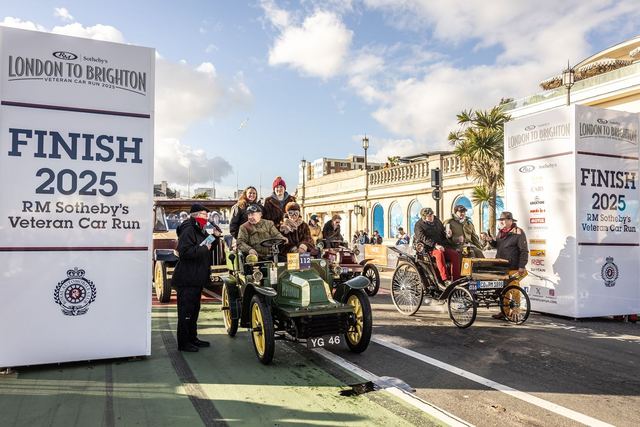 Objects of DesireSixty miles at fourteen miles an hour: Brighton and the beautiful machineA veteran run born of a law, Goodwood in period dress, two drives and the oldest electric railway.
 Objects of DesireA concert hall built for horses: Brighton’s sound, from the Dome to the record racksRoyal stables turned concert hall, a Victorian club on the beach, an indie record shop and hi-fi.