Gaming
Ultrawide monitors and gaming sound: the big screens and the speakers
The great ultrawide OLEDs, what 240, 360 and 1,100Hz really buy, and the best headsets and speakers.

Sit before a 49-inch curved monitor for the first time and the room quietly disappears: the screen fills your side vision the way a windscreen does. Here are the ultrawides worth the desk space, what the numbers on the box actually buy you, and the headsets and speakers that complete the illusion.
Why ultrawide?
An ultrawide monitor is the gaming equivalent of a panoramic windscreen. A 49-inch 32:9 screen at 5120 x 1440 holds exactly the pixels of two 27-inch 1440p monitors side by side, without the bezel down the middle, and in a driving or flight game the extra width falls just where your side vision expects the world to be. Spreadsheets love it too, which comes in handy when justifying the purchase.
Before you buy, ask what you will plug in. PlayStation 5 and Xbox Series X|S send a 16:9 picture, so on an ultrawide they play in the middle with black bars at either side. Ultrawides are a PC pleasure, and only in games written to fill the shape. If the console is your main machine, a large 4K television or a 16:9 OLED monitor will serve you better, and leave the ultrawide to the study.
Samsung Odyssey OLED G9 vs LG UltraGear evo GX9
Samsung’s Odyssey OLED G9 is the screen that made the 49-inch format desirable: a QD-OLED panel at 5120 x 1440, 240Hz, a 0.03 ms response time and an 1800R curve. The 2027 version, unveiled in August 2026, raises the stakes to 360Hz, or 720Hz in a lower-resolution Dual Mode, on a fifth-generation Penta Tandem panel that Samsung says lasts up to twice as long and peaks at 1,300 nits.
Samsung has not yet given its price or date, so for now it is a promise with very good specifications.
LG’s answer is taller rather than wider. The UltraGear evo GX9 (39GX950B) is a 39-inch 21:9 OLED at 5K2K, 5120 x 2160: the same width in pixels as the Samsung, half as much again in height. It runs at 165Hz, or 330Hz at a lower resolution, with a 1500R curve, 0.03 ms response and a built-in AI upscaler that sharpens lower-resolution pictures towards 5K. LG listed it at £1,599.99.
Feeding 5K2K at high frame rates takes a serious graphics card, so budget for both.
Which suits whom? The Samsung for racing and flight simulators, where width is everything and the curve wraps the cockpit around you. The LG for open-world adventures and for work, where height and sharpness matter more than sweep, and text looks printed rather than lit. LG also makes a 52-inch 5K2K UltraGear evo at 240Hz, which it calls the largest of its kind, for those whose desk is really a runway.
Alienware 34: the ultrawide most people should buy
Alienware’s AW3426DW is the sensible ultrawide, and there is nothing dull about it: 34 inches at 3440 x 1440, a Penta Tandem QD-OLED at 280Hz and 0.03 ms, up to 1,300 nits at its brightest, an 1800R curve, Dolby Vision and a three-year warranty that covers burn-in, for $799.99. It fits an ordinary desk, asks far less of a graphics card than 5K, and is where most players will find the best picture for their money.
What the hertz really buy
Refresh rate is how many times a second the screen can draw a new picture. Moving from 60Hz to 144Hz is the change you feel in the first minute; 240Hz makes fast motion crisp rather than smeared; beyond that, the gains narrow for most of us and matter chiefly to competitive players, for whom a few milliseconds separate hero from spectator. And a screen can only show the frames the graphics card actually produces, so match the two.
The race has become gloriously excessive. Samsung’s 27-inch Odyssey G6 reaches 1,100Hz at HD resolution through Dual Mode, or 600Hz at 1440p, and Samsung said it would reach shops in the second half of 2026. LG’s UltraGear 27GX790B is a 540Hz 1440p OLED. Such numbers are for the esports professional, and their real promise is a psychological one: whatever went wrong in the final, it was not the screen.
Buy the screen for the games you actually play: a racing seat wants width, a shooter wants speed.
OLED or Mini LED?
Response time is how quickly a pixel changes colour: OLEDs quote 0.03 ms, fast LCDs around 1 ms, and both are now quick enough that blur depends more on refresh rate than on the panel. The real choice, then, is between two kinds of light. OLED lights every pixel itself, so black is truly black and a starfield looks like the night sky.
Mini LED uses thousands of tiny backlights, 2,304 dimming zones on LG’s 27-inch GM9, and wins on sheer brightness, up to 1,250 nits.
OLED’s old worry is burn-in, the ghost of a static image left on the screen. Makers have answered with new panel designs and longer warranties, and Alienware’s three years of burn-in cover tells you two things at once: the risk is real, and the maker is confident in the cure. If you play one game with a fixed map in the corner for hours every day, or work all day on the same screen, Mini LED is the calmer choice.
What the curve means
The R number is the radius of the curve in millimetres. 1800R is the bend of a circle with a radius of 1.8 metres; 1000R is tighter, a radius of one metre, and brings the edges closer to your line of sight. The wider the screen, the more curve it needs to keep its far corners in view. On a 34-inch, 1800R is gentle and easy to live with; on a 49-inch, the curve is what stops you turning your head like a tennis umpire.
Gaming headsets: SteelSeries vs Audeze
Sound is the half of gaming people forget to budget for, and in a shooter it is the half that tells you where the danger is. SteelSeries’ Arctis Nova Elite is the luxury choice: 40 mm carbon-fibre drivers on brass surrounds, certified hi-res wireless at 96kHz/24-bit, noise cancellation, and a GameHub base that connects several devices at once. At £599.99 it is among the most expensive gaming headsets on sale, and sounds every penny of it.
Audeze’s Maxwell 2 takes the audiophile route: 90 mm planar magnetic drivers, the technology of studio headphones, with Audeze quoting 80 hours of battery. It costs £339 for PlayStation and £369 for Xbox, the difference down to Microsoft’s licence. It is heavy, and long sessions warm the ears, but footsteps arrive with an unnerving precision. The question is simple: do you want luxury and features, or the most sound for the money?
Soundbars and desk speakers
In the living room, a soundbar turns a console into a cinema. Sonos’s Arc Ultra fits 14 drivers into a bar 1,178 mm long, including Sound Motion, a four-motor woofer that finds deep bass in a slim body, and plays Dolby Atmos in a 9.1.4 arrangement over HDMI eARC. It lists at £999. PS5 owners get a bonus: Sony’s Tempest 3D Audio works through television speakers as well as headphones, so even the set’s own speakers get a little theatre.
At the desk, Razer’s Leviathan V2 Pro does something faintly uncanny: an infrared camera follows your head while beamforming steers the sound to your ears, so a virtual surround field stays with you as you lean in. Five 2-inch drivers, a down-firing subwoofer and THX Spatial Audio, from $499.99. Logitech’s G560 is the extrovert: two satellites and a subwoofer with 240 W peak, DTS:X Ultra surround and LIGHTSYNC lighting that reacts to the game. Neighbours, be warned.
The verdict
For racing and flight, the 49-inch Samsung Odyssey OLED G9. For open worlds and work, LG’s 39-inch GX9. For most desks and most budgets, the Alienware 34. For competitive shooters, the fastest 27-inch screen your graphics card can feed. Then the sound: the Maxwell 2 for value, the Arctis Nova Elite for every luxury, the Arc Ultra for the living room and the Leviathan V2 Pro for the desk.
Why it's on our list
- The 49-inch and 39-inch ultrawides
- 240, 360 and 1,100Hz, explained
- OLED or Mini LED, and what curves mean
- The headsets worth wearing
- Soundbars and desk speakers
Location
The map comes from Google Maps, which sets its own cookies once it loads.
More in depth
 GamingThe top 10 games right nowThe ten games selling hardest right now, and the new releases worth the wait this winter.
 GamingGrand Theft Auto VI: the making of a phenomenonFrom Dundee to Vice City: every GTA through the years, and why GTA VI is the launch of the decade.
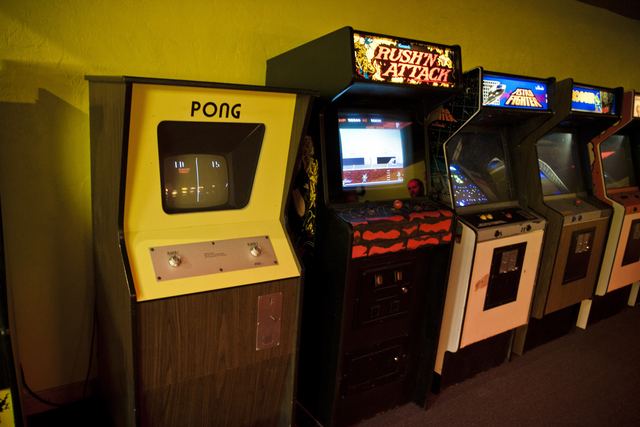 GamingFrom Space Invaders to Vice City: 50 years of video gamesFrom Pong to GTA VI: the consoles, computers and games that made fifty years of play.